
History of
The Forester
From a working countrymen's local, to a bit of a biker's pub in the 1970s, to an up-market gastro-pub with a Michelin bib award, and some very well-known celebrity customers, the Forester has seen many changes over the several centuries of its existence.
Its story even encompasses a slice of history from Colonial America, and a bizarre moment in the recent history of North Korea. So it could be claimed (if with tongue in cheek) said that our pub has a global reach.
However it is as a local, the beating heart of our village social life, that we are working hard to save it, and restore it to its rightful place in the village.
![IMG-20260219-WA0001[1]_edited.png](https://static.wixstatic.com/media/e4b014_099e7cf709104874ad26ef6c4da3e560~mv2.png/v1/fill/w_491,h_331,al_c,q_85,usm_0.66_1.00_0.01,enc_avif,quality_auto/e4b014_099e7cf709104874ad26ef6c4da3e560~mv2.png)
Anglo Saxon beginnings
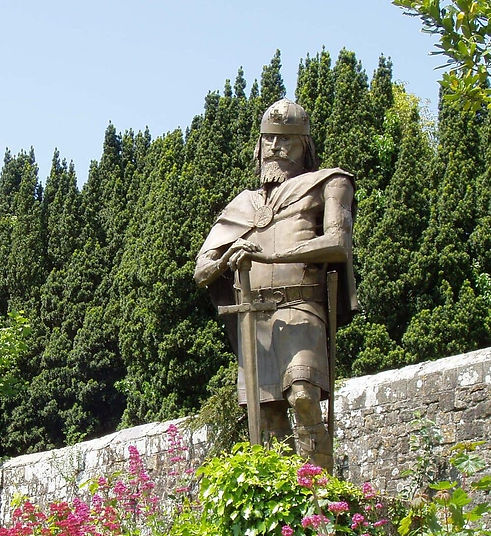
For centuries, by far the largest landowner and greatest power in the area was Shaftesbury Abbey, with the Abbess of Shaftesbury, one of the wealthiest and most influential women in England. Indeed a medieval joke had it that if the Abbess of Shaftesbury married the Abbot of Glastonbury, their heir would be richer than the King himself.
The Abbey was founded in about AD 888 by Alfred the Great, the first abbess being his daughter Aethelgifu. (Given that Alfred himself is the 32nd great grandfather of our present King, this makes Aethelgifu his 31st great aunt.)
Among the many possessions of the Abbey were the Donheads, and without doubt the land where the Forester now stands, or perhaps an earlier building. The Abbey held 40 hides here and with a hide being around 120 acres, this would have been the entire parish. In addition, the church of St Andrew's still has the Abbey coat of arms in its East window, and to this day there is still a footpath leading directly from the church of St Mary's straight to the Abbey site in Shaftesbury.
English Civil War
The Forester building itself dates back to the 17th century, most probably to the 1650s, which raises the distinct possibility that the stones to build it were 'liberated' from the ruins of nearby Old Wardour Castle (a much cheaper option than quarrying them afresh!)
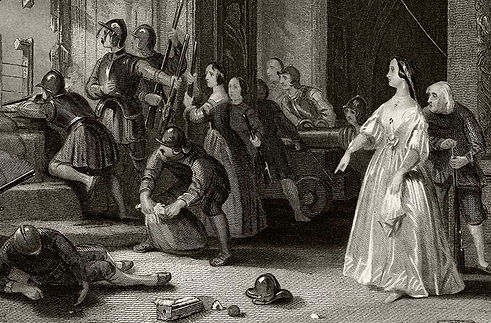
The Castle was destroyed in 1643 by two huge mines, after a 4-month siege by a Parliamentarian army of some 1,300. Defending the castle were just 25 serving-men of fighting age, led by the redoubtable Lady Blanche Arundel, aged 60. When the besieging forces had demanded the surrender of the castle, Lady Blanche replied that it would be defended 'to the last extremity.'
It should be added that a less romantic story, now the official version told by English Heritage, is that the damage was actually done by Royalists whilst recapturing the castle from the Parliamentarians. Either way, it's highly likely stones from the now abandoned were used for building many of the older houses in the Donheads, a suspiciously large number of which appear to have their origins around this time … and these would include our pub.

The local
Over the years the building served as both a blacksmith's and a weaver's shop, but by the 19th century it was very much a village inn.
For generations the Forester was known as the New Inn, and was the quintessential working man's pub, although women certainly visited as well – if only 'to drag their husbands out of it,' as one memory has it. And it boasted the usual array of colourful rural characters. One old timer used to occupy the same seat ever evening, and woe betide anyone who he found already installed in it when he arrived. In the summer he would work on the local farms thatching the hay ricks to keep the rain off. But before ascending the ladder he would always start work with the same request to the farmer. 'I'll have two quarts of that cider of yours please. ' His enthusiasm for Donhead cider continued at the pub, and he lived well into his eighties.
Another well-known village character, according to the wonderful history of our village, Donheads Past and Present, was Dratty Litten, who in the 1930s was able to head off for a night at the Forester with just one shilling in his pocket. From this he could buy all the tobacco he needed, and so much ale that he had to be wheeled home in a dog cart. 'This shows how little it took to have a good night out with your neighbours', observe the authors.
Beyond crisps and a few bar snacks, food was not on sale. This was very much a place to meet for a pint, gossip, and then head home for dinner. It was also a meeting place for a very special kind of society, the Ancient Order of Foresters, whose regular meetings here caused the name to be changed from the New Inn to the Forester we know today.
The Ancient Order of Foresters
Before the Welfare State, working families formed mutual aid and support groups of their own. One such was the Ancient Order of Foresters, dating from 1790, founded on a shared duty to assist their fellow men who fell into need as they walked through the forest of life. “Like many of the great British inventions they seem to have been developed over a pint in the local pub,” as one historian puts it.
Every week each member of the society would meet at a 'Court', usually in a local pub, and pay in a small sum of money, a sixpence or a shilling. Whenever times got hard, due to ill health, unemployment or even, it was said, 'an unplanned baby' , members could request assistance from the pot.
Dairy farmers formed 'Cow clubs', while other societies include the Ancient Order of Shepherds, the Amalgamated Order of Comical Fellows, and the Halifax United Order of the Peaceful Dove Friendly Society. Foresters societies sprang up in densely wooded areas, and by 1945 there were 3,111 different branches, with an astonishing half a million members.
There are still villagers in Donhead today who remember the old-style Ancient Order of Foresters, the regalia, and the jolly meetings. Today the society is still a mutual fund, with £250 million under management for its members.


Anne Arundel County Courthouse in Annapolis, Maryland
The global reach of our pub
After the Dissolution of the Monasteries, much of the Donheads passed into the ownership of the Arundel family, including the land on which today's Forester stands. And remarkably, an entire county today in Maryland, USA, is named after a true daughter of the Donheads, born in the Parish at Old Wardour Castle: Lady Anne Arundel (1615-1649). She married Lord Baltimore, the founder of Maryland, bore 9 children, and upon her death, he named Maryland's third county, Anne Arundel County, after her.
Our pub also has a remarkable connection to North Korea. During the mid 20th century it was owned by the Trowbridge brewery of Ushers. When Ushers sadly closed down in 2000, after 175 years, their brewing equipment which had supplied beer to our pub for decades, was bought up by Kim Jong Il and shipped to North Korea, where it continues to be used to brew the country's premier pint, called Taegongdang.
Modern times
Despite memories of the Forester being something of a bikers / heavy metal pub in the 1970s, possibly owned by a rock guitarist, we haven't been able to substantiate this yet. (More research needed.) But most recently it evolved into a superb gastro-pub which appealed to some of the best known-local celebrities, including Guy Ritchie and Madonna.
The late 20th century saw the closing of numerous pubs in the area, including the Carpenters Arms, the Royal Oak, the Lamb Inn, the Glove (a coaching inn at the bottom off the notoriously steep White Sheet Hill) and the Castle Inn, known colloquially as Picket's Place, because it was run by an ex-policeman called PC Picket.
All of these are now sadly gone, but the Forester survived them all, right up until its recent closure.
As the 'last man standing', therefore, from among this formerly rich array of local pubs and inns, it is hard to exaggerate the importance of this crucial community meeting, drinking and gossiping place for our village.
